
As time went by, different facets of the Hindi cinema started showing the complicated identity of Muslim -- sometimes tendentious and at other times perverse and unreliable.

Two senior faculty members of Aligarh Muslim University (AMU) exchanged blows in an official meeting, leading to a possible departmental action. A video of the incident, which occurred on Sunday, has since surfaced on social media. The reason for the fight is still unknown, but AMU sources say it stemmed from a long-standing misunderstanding between the two professors.

Even after 50 years, Sholay remains a lasting reminder of unity, shared memories and the joy of cinema, notes Mohammad Asim Siddiqui.


'The writers fear that the fringe is threatening to become the mainstream and the liberal space -- a must for any creative expression -- is fast shrinking,' says Mohammad Asim Siddiqui.

Any subject is good enough for producing good art. Piku, and its obsession with 'emotion resulting from motion' is a perfect example, says Mohammad Asim Siddiqui.

Majaz, based on the life of Asraul Haq Majaz, the John Keats of Urdu poetry, marks Talat Aziz's debut as a composer in Hindi cinema. The film could have been an excellent biopic had it stuck to the poet's poetic self rather than his unfulfilled love, says Mohammad Asim Siddiqui.

'The Muslim identity of the family appears incidental to the subject of the film...' 'The self-sacrificing, suffering mother film could have belonged to any religion.' 'The abusive father, who prefers his son to his daughter, could have followed any religion.' 'That the Muslim household is remarkably free from religious symbolism is also the strength of the film,' feels Mohammad Asim Siddiqui.

'The most important aspect of Bajrangi Bhaijaan is the use of humour to touch some sensitive and potentially explosive political-religious and cultural subjects.'

Dil Dhadakne Do joins the debate over the role of women in India.

'While there cannot be any doubt that the national anthem should be shown utmost respect, cinema halls are not the most appropriate places to play the national anthem.'

It is ironic that Raja Mahendra Pratap's Jat connection is being used for vote bank politics. He could not have cared less for his caste.' 'He was aware of the hold caste had on people's lives, and always rose above this kind of narrow thinking.' 'He mentions that once when he landed at Dwarka the priests asked him about his caste. He replied that he was a sweeper. The priests denied him entry. "I did not care to visit it," he writes, "when it was surrounded by people who had no regard for humanity".'

More than anything else, Pathaan is a silent and subtle statement of Shah Rukh Khan about his place, his commitment to cinema and, if one can say, his politics, observes Mohammad Asim Siddiqui.

'Does Deepika not have the right to raise her voice in a democratic and peaceful manner on an issue she considers important?' 'Why should one view her only as an actor and not appreciate her role as a concerned citizen of the country?' ask Aftab Alam and Mohammad Asim Siddiqui.

'It is beyond him to understand how human beings can say the same thing to mean so many different things.'

Dilip Kumar remained in demand all through his career because he kept reinventing himself in keeping with the changing times in Indian cinema, argues Mohammad Asim Siddiqui.

District authorities categorically denied having imposed any "ban" on the controversial film Aligarh, based on the life of a gay AMU professor.

Bajirao Mastani has the potential to do for Maratha 'history' what Mughal-e-Azam did for Mughal 'history', says Mohammad Asim Siddiqui.

What has not changed in a decade is the character of Rizwan Khan. He is complex, multi-dimensional and lovable. In fact, his character continues to grow on you, notes Mohammad Asim Siddiqui.
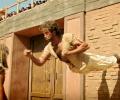
'Ashutosh Gowariker's Mohenjo Daro does what many history books could not have done.' 'He awakens interest in the ancient civilisation of Harapppa and Mohenjo Daro,' says Asim Siddiqui.

The ordinary life lived in Pakistan is rarely a part of Indian imagination. This is this gap that Pakistani television serials have succeeded in bridging, says Mohammad Asim Siddiqui.

Aligarh mayor from BJP strongly backed an official ban on the movie Aligarh, claiming the movie is a "conspiracy" to defame the city.

The hounding of former AMU students by some alumni over their 'wining and dining' during Ramzan is deeply disturbing, says AMU Professor Mohammad Sajjad. 'Intolerance, irrationality, bigotry, religious/sectarian hatred, and all such pernicious tendencies must be fought and resisted, more particularly by university campuses, in order to build a better society.' 'Have we, as academics, failed, and that too, quite miserably?' he asks. 'I feel like confessing and saying yes, we have indeed failed.'
